Becoming a Real New Yorker

In my continuing quest to become a real New Yorker, I went to the DMV.  It’s pretty far, but I walk because that’s what New Yorkers do.

I get in line to talk to a woman who is telling us which line to get in.

I smile and say, “I’m here to get a New York driver’s license.”

She points.  I get in a second line.

After a long wait I smile and say, “I’m here to get a New York driver’s license.”

A woman who is already having a long day says, “Old license, three forms of identification.”

I hand her my old license, social security card, passport, and birth certificate.

She asks, “Why would I want your birth certificate?”
“I’m sorry.  I thought you said three forms.”

“The passport counts for two.”

“Yes, ma’am.”

“You’re B512.  Listen for your number.”

I know that my number was B512 because I was B512 for several hours.  I am finally called to window 19, where a man who wishes he was somewhere else asks to see my old license and three forms of identification.  I don’t offer my birth certificate, but I’m ready.

I say, “It’s pretty busy today.”

He says, “Go wait for your number.”

I sit for a long time.  After a few hours I decide to send a picture to Carol so she can see where I’m spending the day.  A police officer rushes to make it clear that I will go to prison if I take a picture inside the DMV.

I almost say, “But I want it for my Christmas card,” but then think better of it.

They finally call B512 to window 32, where the clerk complains that I should have been sent to a different window.  When she sees my old driver’s license she says, “If I could get to Georgia I would never come back to Brooklyn.”

This is probably not what the Chamber of Commerce wants government employees to say.

Some institutions treat us like a number instead of a person.  Some people make us feel unimportant.  We need a place where we matter.  We need a family that cares for us.  We come to Plymouth because we are important.  We come to church to remember that we are God’s children.

BrettYounger_SignatureTransparent

Share

Step by Step

Anne Lamott writes about the time her brother waited until the night before his huge research paper on birds was due to begin working on it. He sat at the family table, surrounded by stacks of bird books, completely overwhelmed, as much a mess as the table was. How could he do this? Where should he start?

His father sat down beside him, put his arm around his shoulders, leaned in, and said, “Bird by bird, Buddy. Bird by bird.” He gave his son a way to move forward.

Following Christ feels overwhelming sometimes. We want faith that moves mountains, courage that overcomes fear, love that changes the world. We picture who we want to be spiritually, then we look at the messy situations that surround us and wonder how in the world we will get from Point A to Point B. The distance seems too great. Time too short. Opportunities too wasted. Where would we start?

In those moments when we’re overwhelmed by how far we have to go, God leans in, and offers what we need. “Step by step, child. Follow me, step by step.”

We want to live with Christ’s courage, so God shows us the people we find intimidating. God leans in and nudges us to speak to them anyway, then listen for their response, then prepare to do this again and again.

We want to live with Christ’s hope, so God leans in and shows us children we can learn from, enjoy, and befriend. We find a struggling parent who needs to know someone notices and cares. So we offer a friendly word, a shoulder, a listening ear, a plate of brownies. We spread those acts of joy that we can offer, those things that we can do. We watch for the steps God invites us to take.

We want to live with Christ’s love, so God leans in and says, “Do you see that person?” Being thankful for that task they did will change their day. Noticing who needs what we can give and giving it moves us closer to Christ, step by step. A selfless gift given, a gracious gesture made, a prayer lifted on their behalf, a question bravely asked that changes a difficult situation. Small steps from apathy to compassion draw us closer to Christ. Doing small things with great love, as Mother Teresa said, are the ways we follow.

Share

A Long List of Things Your Senior Minister Wants

Roy Oswald writes about churches selecting a new Senior Minister: “No matter how much work has been done in terms of self-study, goal setting, and job description, the selection of a new pastor is not a rational decision.  The decision is deeply intuitive with a good deal of blindness connected with it.”

Love may be blind, but we are together for better or worse, so I want you to know what my goals are, recognizing that I have only been on the job for three weeks.  I plan to get more rational.

I want to ride the subway without repeatedly looking at the map to make sure the train is still headed in the right direction.

I want to go a day without consulting my gps.

I want to honk my horn like a New Yorker.

I want to go into a grocery store and think, “That’s a reasonable price for a pound of ground beef.”

I want to look at a restaurant menu without sticker shock, “How can a Coca-Cola here be three times as good as a Coca-Cola in Georgia?”

I want to go to a Mets-Braves game without secretly rooting for Atlanta.

I want to convince myself that climbing stairs counts like a trip to the gym.

I want to feel at home at Plymouth.  I want to know names—including the 22 Davids listed in the church directory.

I want to learn our history as a way of visioning the future.  I thank God for Henry Ward Beecher, Sojourner Truth, Martin Luther King, Jr., David Fisher, and Al Bunis.  I want to be grateful for where we have been as well as where we are going.

I want to learn how we tell our story.  Plymouth is a gift to our community. You and I have friends and neighbors who need this church.  We need to let them know we are here for them.

I want to understand how we learn the Christian story together.  The best Christian education is not just learning content, but becoming more like Christ.  How do we do that at Plymouth?

I want to help people find friends.  I want to know which groups will be the best family for which newcomers.

I want to know about the ways we care for the hurting.  Our ministries help us become the people God wants us to be.

I want to continue to feel God’s presence when I walk into the sanctuary.

I want to have a part in our worship growing deeper.  I love our worship, and have no desire to change things for change’s sake.  The goal is to strengthen our worship so that we can more fully give ourselves to God.

I want to be a good person as well as a good senior minister.  I want to set up patterns for well-being and growth: prayer, exercise, and study.

I want to give guidance, support, and care to the leadership and staff of Plymouth.

I want to understand the structure of the church’s ministry, to ascertain what organizational needs we have.

Eventually I want someone to introduce me by saying, “This is our Senior Minister.  He’s not that new.”

Carol and I came to Plymouth to be part of the family.  I want to hear your stories, and I want to share my story.  I want to move past being acquaintances and become friends.  I want to be real church.

BrettYounger_SignatureTransparent

Share

How should we pray for Orlando?

Before worship on Sunday I checked the news about the tragic shooting in Orlando.  The report at the time was that 20 people were dead.  During worship we prayed for the families of the victims.  By Sunday afternoon the number of dead had risen to 50.

That does not seem right, but it happened in lots of churches.  We prayed for the families of 20 people who had been killed, and then the news got even worse.

We have way too much evidence that prayer does not work the way we wish prayer would work.  Prayer does not keep the news from getting worse.  Prayer does not protect innocent people.  Prayer does not prevent hateful people from buying guns.

We have gotten used to praying after horrific events; Littleton, 2012, 12 deaths; Newtown, 2012, 28 deaths; San Bernardino, 2015, 14 deaths.  Each time, our hearts are broken.  Each time, we pray fervently.  Each time, we remember the lives snatched away by gun violence.  Each time, we experience grief and despair.  Each time, nothing seems to change.    We have started to feel numb to it.

We do not need to pray silently.  We need to make our voices heard.  People who pray do not have to agree on the exact interpretation of the Second Amendment to agree that gun violence is a national tragedy.  We can point out that there are options between taking all the guns away and the AR-15s that keep being the instrument in these shootings remaining readily available.  4 of 5 NRA members support expanded background checks.  There is plenty of room for improvement in the space between the two sides in this debate.

People who pray need to talk to their elected officials before the next tragedy.  Innocent people are murdered with weapons specifically designed for killing and we behave as if nothing can be done, but representatives do change their position when enough people speak up.  We can push for common-sense gun laws that will prevent more tragic bloodshed.  People who pray should protest gun shows—where many of the rules about background checks and waiting periods do not apply.  We need to work for change that will make our communities safer.

We have gotten too used to praying after mass shootings.  We have to do more.  Our prayers will feel routine until we pray, “God, show me what I can do.”

BrettYounger_SignatureTransparent

Share

Prayer for Our Church

Heavenly father, we have witnessed many times before that even the tiniest part of your perspective and wisdom is far greater than any of us ever seem to imagine.

Know that it is our desire that your vision become our vision, and that OUR focus be on you and you alone.

Forgive us for the infamous Brooklyn sin of ever thinking that we might know better, and for ever knowing that we think better.

Help us here and now to humbly see beyond what we think we know.

This day is not about Plymouth.

This day is not about Brett.

Help us to see that this day is about you with their help.

Take us now into your hands,

so that we may feel your way,

so that we may think your way,

so that we may truly live and walk your way here at Plymouth and beyond,

just as your son Jesus taught us to do.

For nearly 170 years it has been our privilege and honor to walk with you here at Plymouth and we thank you for guiding us on that journey.

As we enter this new chapter with Brett and Carol, we ask for your guidance that there not be a needy person among us, between us, or around us.

We ask that you reach far back and beyond to bind a new and growing Plymouth together to feel as though it’s “of one heart and soul.”

We ask that we feel now, more than ever, that everything we own is not ours, but yours.

We ask you to help us to live out the Great Grace of which you speak, so that it may enlighten and inspire us to be truly humble stewards of your place, this place, its property, and its people.

We ask your help in showing our greater Brooklyn community, and each of us how to live out this Great Grace such that we may extend it to Brett and Carol with all the love and generosity that they should expect from being a part of your great kingdom…and a sweet place they now call home.

We ask all of this in Jesus’s name.

Amen

Share

Happy to Be Here

“Moving Day” has all the initial appeal of “Income Tax Day,” “Root Canal Day,” or “Commitment Sunday.”  We should admire the people at Mayflower, because it’s honest to name your moving company after a long, miserable trip on which everyone got sick.

While a few of our boxes were accurately labeled “Towels, linens,” I was surprised to find boxes marked “miscellaneous,” “leftovers,” and “under the bed.”  Seven boxes of “Christmas stuff” seems excessive.

I am still wondering: “Where did we get all this stuff?  Why do we have a tripod?  Do we need high school annuals?  Is this our chair?”

But by the grace of God and the goodness of the people of Plymouth, moving day/week has been a gift.  We walked in the door to find two big, beautiful cards from the children welcoming us to Plymouth.  Good people came on Sunday and waited with us for the moving van that showed up nine hours late and took out several garbage cans on Hicks Street.  Saints spent their Memorial Day unpacking boxes.  They taught us how to bag recycling, critique every restaurant in Brooklyn, and, by the end of the day, sit on a stoop exhausted.

The parade of food has been amazing.  We recognize that most people do not know the joy of moving into a house where the refrigerator is filled.  People have been bringing meals and goodies.  New York Bagels are not over-rated.  Everything with Brooklyn in the name works—Chocolate Brooklyn Babka, Brooklyn Lager.  We are eating well.

Moving reminds me how wonderfully fortunate I am and how incredibly dependent we all are.  I depend on friends, family, and friends who become family.  The church is made up of those who recognize that they do not have the ability, need, or desire to make it on their own, because we are in this together.

Henri Nouwen said that he lived with the fantasy that every time he landed at an airport he would be met by someone he knew shouting, “Hey, Henri.”

Predictably, Nouwen knew a lot of disappointments.  Each time that he got off a plane and no familiar figure was there to meet him, Nouwen thought to himself: “It’s all right.  When I get home my friends will be there.”

Out of that consolation, Nouwen came to a wonderful conclusion about the nature of eternity: “Heaven is going to be like that.  God will be there and will say, ‘Hey, Henri, how was it?  Let’s see your pictures.’”

That’s how God’s people greet one another.  From the moment we arrived, friends have been shouting: “Hey, Brett.  Come on in.  Welcome home.”

BrettYounger_SignatureTransparent

Share

There are a couple of ways to look at it….

From the outside, Plymouth Church appears to be a very wealthy church.  It has beautiful buildings occupying valuable land.  It has a robust endowment.  It has generous congregation.  In all of these areas and more, Plymouth is indeed a wealthy church.

But if you look at it another way, Plymouth possesses nothing.  That’s right, nothing.  Plymouth does not own anything – it does not own its building, its land, and its endowment.  Plymouth is the steward of these material goods, entrusted to Plymouth over the years by dedicated members and generous donors.  They do not belong to Plymouth.  They belong to God.  Plymouth is entrusted with the stewardship and wise use of these blessings.  Plymouth, as a Congregational Church, elects its representative leadership, and asks that leadership to set priorities for how to manage the gifts in Plymouth’s custody. That is why, every year, Plymouth makes and votes on a budget.  The budget is the clear indicator of how Plymouth is choosing to use the resources with which it has been entrusted.  The budget is created by the leadership and voted on by the congregation.  We are in this together.

Plymouth Church operates in good faith, attempting to employ these resources where they can do the most good in forwarding the Kingdom of God.  Some resources go directly to help those most vulnerable and in need – victims of human trafficking, casualties of natural disasters, children in need of education and food.  Other resources go to help those in spiritual need, and for this reason, Plymouth engages a top-notch staff, maintains a welcoming building, empowers a confident choir, all of which support the work of the community that gathers around Plymouth.

Every story is complicated, and this one is no exception.  Some donors have made very generous gifts to Plymouth that carried restrictions in how they may be used, and the income from those gifts can only be spent on specific things.  To act with integrity, the leadership must deploy those resources in accordance with the wishes of the donor.  Plymouth might wish to use those funds in other ways, but it must keep faith with the donors

The gifts that bless Plymouth the most are the one that have no restrictions. Given from the heart, they allow the leadership and the congregation to set the priories of the church and use its resources advancing those priorities.  And those priorities, in Brooklyn Heights and beyond, will advance the Kingdom of God.

The Stewardship Ministry invites you to prayerfully consider what you are able to give to support the work of Plymouth Church in the upcoming year.  Plymouth’s year begins in July, and we know that seems like a lifetime away, but it is important for you to go on record now. Please take a few minutes to make your commitment this week – before Anniversary Sunday.  Help us celebrate our 170th Anniversary but contemplating what we can accomplish before our 171st Anniversary.

Please be generous in your support of the work of Plymouth Church.  Click Here to Make Your Commitment.

In Christian Fellowship,

Jacque Jones

Stewardship Chair

Share

Free is Better Than Half Price

A couple of years ago, I purchased a membership to a local arts organization.  It was a modest membership but it bought me some small graces.  I get advance notice of events and I can purchase movie tickets for half-price.  I suppose I know that a few dollars of my membership goes to support the work of that organization, but that was not my motive in joining.  I joined for the benefits I receive.

The Kingdom of God runs on a different operating principal.  As Christians, we believe that the grace of God is freely given – it can never be bought and it can never be sold.  To loosely quote Philip Yancy – there is nothing we can do that will make God love us more, and there is nothing we can do that will make God love us less.  Isn’t that amazing?  Doesn’t that take your breath away?

But that extravagant grace comes with an invitation.  God has invited us to continue Christ’s work on earth and that is what Plymouth Church exists to do.  How can we not gratefully support the work of the church as an act of our God-given free will?  We can never match the extravagance of God, and we shouldn’t try, but we can give generously from our personal resources to support the faithful work of this community of Christians.

The Plymouth Stewardship Ministry is inviting you to go on record with your commitment for 2016-2017, and to do this prior to May 1. You can go online to make your commitment or use a commitment card available at the Stewardship table in Fellowship Hour. Alternatively, you can speak to a member of the Stewardship Ministry or staff who will be happy to assist you.

Please be generous in your support of the work of Plymouth Church.  Click Here to Make Your Commitment.

Share

Reflections on “On Common Ground” Women’s Retreat

What makes us unique? What do we share?

These were the two questions Jane Huber set before 45 women on Saturday, January 30th during the Annual Women’s Retreat. This year, the theme was “On Common Ground.” Had super storm Jonas not come through, it would have been the weekend after the Church’s Anti-Human Trafficking event however, instead it almost divinely preceded the current challenge to our congregation.

To be honest, I’ve been struggling with my experience of the retreat, to no fault of Jane or any participant, but I think because I came in with too much of an ego mindset. I was identifying more with what I’d get out of it, rather than being open to what would happen. I was also therefore identifying with whether or not other people would enjoy it. That anxiety got translated into, “what did I get from it? What did others? And where would it lead me/them?”

Throughout the weekend, I found myself wondering: did I learn more about how to find Common Ground? If so, what did I learn? If not, does that mean I didn’t get the benefit of Jane’s amazingly well thought-out program?

In the first part of the morning, Jane had us look at a passage from Acts 17:22-31 in which Paul is able to get the attention of the Athenians and explain the concept of his God versus theirs. She asked us to look at where we saw Paul establishing common ground and who, or what, is Paul’s God. The passage ends with him using the words of the Athenians’ own poets to explain his concept of his (and our) God saying, “For ‘In him we live and move and have our being…For we too are his offspring.’” In other words, God is in each of us, not in a shrine.

In Tom’s sermon the next day, just before the anti-trafficking event, he explained: “the core of our faith is to love God and our neighbors as we love ourselves. It’s not that we are to think poorly of ourselves, but that we are to think of others, and want for them the best out of life, just as we seek that for ourselves. In other words, true prophecy is characterized by being propelled as much for the love of others, as by the love of self.”

Taken together, this is a powerful new notion of God that I now have as a result of this retreat. I have already been learning that if God is in each of us, then knowing my uniqueness is a way of knowing God. But what I got from Jane on Saturday was that if knowing my uniqueness allows me to know what you and I share, then it is a compassionate way of learning how to love you and want for you, as I love and want for myself. And if I can get myself there, then I have expanded my visceral knowing of God. I imagine this is what it feels like as a parent, that your identity increases in each child. As your identify increases, so too does your connection.

As I find more common ground with others, can my connection to God increase?

Share

What Good is History?

Abolitionist
[ab-uh-lish-uh-nist]
noun
1. (especially prior to the Civil War) a person who advocated or supported the abolition of slavery in the U.S.

I’m a member of Plymouth Church in Brooklyn Heights. After “church shopping” I joined Plymouth because of its stand on social justice issues. Plymouth is proud of its history. Founded in 1854, the congregation called as its first minister Henry Ward Beecher. They gave the famed abolitionist, brother of Harriet Beecher Stowe, a platform – literally – to speak on.

In those turbulent years leading up to the Civil War and through the Emancipation Proclamation Plymouth would be packed on Sundays with close to 3,000 people, come to hear Beecher preach against slavery. Famous anti-slavery advocates spoke at Plymouth, including William Lloyd Garrison, Sojourner Truth, and Frederick Douglass. Plymouth held deep philosophical connections with the Underground Railroad — the secretive network of people who helped slaves escape to the North and Canada. Documentary evidence lends support to the belief that Plymouth was also a site of active participation, known as Brooklyn’s “Grand Central Depot.” Plymouth brought Abraham Lincoln to New York for his famous speech at Cooper Union, that launched Lincoln’s presidential campaign. Here, in Brooklyn Heights, is a place where people gathered who changed history, affecting the lives of millions.

But what benefit is this history?

Fours years ago Plymouth hosted a discussion on human trafficking. I went, hardly knowing what the term meant. Two years ago we revisited the topic. In partnership with the Brooklyn Historical Society we sponsored a round-table discussion moderated by now attorney general, Loretta Lynch. The more I educated myself on human trafficking – on modern day slavery – the more I unearthed facts, metrics, and numbers: There are more slaves in the world today than at the time of the Civil War. Slavery does not happen only overseas, but in the United States. Not just the United States, but all fifty states. In New York. In New York City. In Brooklyn. In my backyard.

The famous historian Marc Bloch, a Jew who joined the French resistance and was killed in Paris by the Gestapo, wrote that the purpose of history is to draw lines of connection from the present to the past, to better understand the impact of our actions, today. Historian George Santayana famously wrote “Those who do not remember the past are condemned to repeat it.”

So how accurate is the definition of abolitionist (above)? Is being an abolitionist, working to abolish slavery, a thing of the past? No. Too much work needs to be done. The New York State Anti-Trafficking Coalition launched a campaign in 2013, New York’s New Abolitionists, to raise awareness around human trafficking and modern-day slavery. It’s a brilliant campaign, drawing lines of connection from abolitionists past to abolitionists working hard to end slavery today: doctors, lawyers, survivors, people from every walk of life. What I’ve learned is that we can all be new abolitionists. Let us not be condemned to repeat history, but to effect change, today.

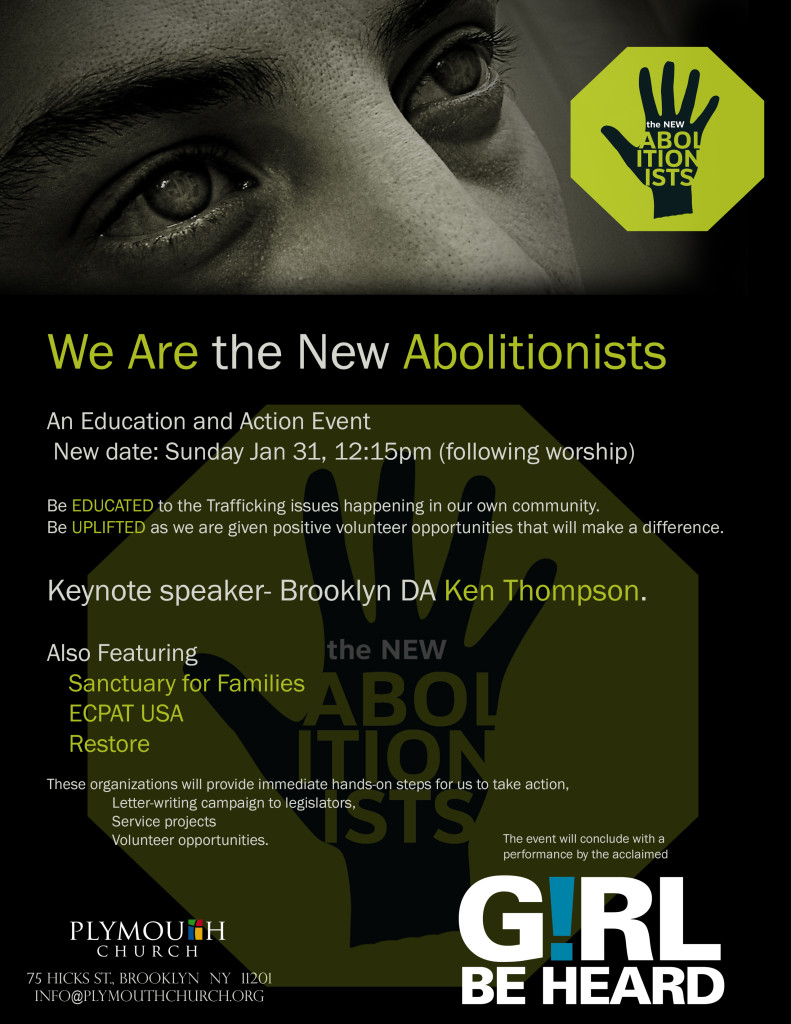
I invite you to come to Plymouth this Sunday: listen to Brooklyn DA Ken Thompson, meet and speak with folks from Restore, ECPAT-USA (End Child Prostitution and Trafficking) and Sanctuary for Families. See and hear the testimony of trafficking survivors given by the activist teen theater group Girl Be Heard. If you already know the story of human trafficking in New York City, come to learn what you can do to to end trafficking. And if you already volunteer, come to meet us, other like-minded folks. Join the crowd. Be an abolitionist. A new abolitionist. Because We Are the New Abolitionists. No one else. Us.

Beth Fleisher, chair
We Are the New Abolitionists
The Anti-trafficking Ministry of
Plymouth Church, Brooklyn

AHTevent_Plymouth_NEW DATE


Share