Marching On

marching-baby

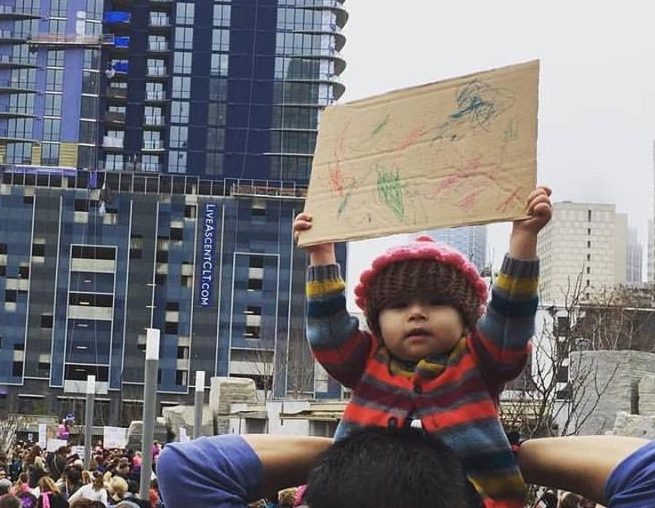
The crowd was spectacular: fathers donning pink hats with ears, women holding bright signs inscribed with colorful language, and little girls wearing t-shirts that said things like “Future President” and “My daddy is a feminist.” Last Saturday’s Women’s March on New York City drew over 200,000. Women, men, children and even some dogs started gathering at Columbus Circle and lined up all along Central Park West, reaching as far north as 72nd Street.

Going to the March was a last minute decision after receiving an invitation to go with a friend. I hadn’t gone to any of the marches last year, mostly because I am claustrophobic and can’t stand being trapped in a sea of people (the 8 am A Train is my living hell). This year I thought I would brave the crowds and see what this marching is all about.

After getting out of the oh-so-congested subway at Columbus Circle, we were greeted by law enforcement instructing us to walk up Broadway. We walked past the Trump International Hotel and Tower. We walked past Lincoln Center, home of The Metropolitan Opera. We walked past a number of male street vendors selling buttons that said things like “Stay Strong, Stay Nasty” and “Girls just wanna have Fun-damental human rights.” Just when it started to feel like we were journeying on a sexual assault trail of tears, we finally arrived at ABC studios, where we could cross over 66th Street toward the park.

“Is this the march?” I heard one woman ask as we turned the corner.

“No,” said her friend. “We are marching to the march.”

Right before we got to the end of the intersection of 66th and Central Park West, the crowd had come to a stand still. Police kept us from joining the rest of protestors. Stuck and frustrated on 66th, we followed the lead of an elderly woman holding a poster that read “My arms are tired from holding this sign since the 1960s” and busted through a side barricade when the police officer was looking the other way.

We were finally on Central Park West and headed north to find an opening that would allow us to cross the park side of the street. Once we crossed, I felt like I was able to breathe again as there was a bit of elbow room. Now that we were done marching to the march, it was time to stand in line for the march. It was tough for me to find the perfect standing and waiting spot. I needed a place where I could feel a part of the crowd, while still maintaining my personal bubble.

We walked down the sidewalk through the crowd and finally stopped by a stone wall that bordered the park. The journey from the subway exit to this resting place had taken us a little less than two hours. We finally claimed a spot and waited for the crowd to start marching.

As we waited, we took it all in. Looking at all the signs, the t-shirts, the various costumes of lady liberty and female genitalia, I was surprised by how many causes were represented: immigration rights, racial justice, LGBTQ+ rights, women’s empowerment groups, disability rights, women’s reproductive rights, women’s and children’s healthcare, peace and reconciliation, environmental protection, science education, anti-human trafficking, domestic violence prevention, sexual harassment and abuse prevention, and children’s rights. There were so many voices shouting in the chorus, “We will not be silent, and we are not going away.”

The intersectionality of the Women’s March was undeniable. People of all races, genders, ages, sexual orientations, religions, education levels and apartment sizes came together as one group to say, “This Matters.”  Yet, in the clamor of it all, I felt lost.

I had journeyed for two hours to this place, only to feel empty. I felt like an outsider, a spectator. It didn’t make sense. I care about these causes. I, too, am angry with the current administration’s negligence towards human rights. I whole-hearted believe in the impact of organizing for social and political change. I am glad we live in a country that gives us the freedom to peacefully protest and speak our minds. But I wanted more. I wanted something that a march just couldn’t provide.

Last Sunday a group of parents got together at Plymouth Church to learn how to talk to our children about racism. This Sunday a group of Plymouth people will watch a documentary and learn how to end human trafficking in Brooklyn. The first Sunday of February, volunteers will pack food bags to give to hungry families through Brooklyn Delivers. When I think of these and the other Plymouth ministries, I realize that social and political activism doesn’t just happen in the streets. It happens in the pews, in the prayer circles, in the baptismal font, in the pulpit, in the offering plate, in Hillis hall, and in the Sunday School classroom.

Church isn’t just a house of worship. Church is an auditorium for the voiceless, an assembly of protest, an incubator for activism, a forum for forgiveness and a place of peace. The Church is continuously marching. There are no barricades to keep people out. There is no waiting around for things to get started. The march is here and now and always.


 

Share

If “The Post” was a Church, We Should All Join

Here are 10 reasons to see The Post:

  1. You have already seen Star Wars.
  2. Films set in the 1970s make you nostalgic for better government.
  3. You want to see a movie with old people in the audience.
  4. You want to see a movie with old people in the movie.
  5. You like films that make your wardrobe seem up to date.
  6. You want to see if Meryl Streep can do an American accent (SPOILER ALERT: She can!).
  7. You are relieved that Tom Hanks has finally gotten a good role.
  8. Steven Spielberg needs your support.
  9. You love movies about Robert McNamara.
  10. You want to remember how good the church could be.

As a New Yorker for almost two years, I am happy to point out the movie begins with the Washington Post getting scooped by the New York Times.  (Our hometown newspaper is surprised that a movie about the Pentagon Papers is called The Post.) Daniel Ellsberg, a former aide to Defense Secretary Robert McNamara, exposed the government’s decades-long history of lies about Vietnam by sending the long report known as the Pentagon Papers to the New York Times. Each administration knew the war was unwinnable, but kept that fact from Congress and the American people.

After a court order halted the New York Times’ publication, the Post got its own copy and had to decide whether to step up, tell the truth, and defy the court order. Kay Graham, publisher of the Post, got the job after her husband’s suicide. As the movie begins, Graham is hanging on to a naïve faith in American leaders.

The newsroom is filled with idealistic reporters who smoke constantly, pound typewriters, pour dimes into pay phones, and send copy to the printer through those cool pneumatic tubes. You feel like there should be ink on your fingers at the end of the movie.

The old-school editor of the Post, Ben Bradlee defends the freedom of the press: “The only way to protect the right to publish is to publish!”

Ben Bagdikian, an old-school reporter, says, “I always wanted to be part of a small revolution.”

When Bagdikian asks Ellsberg why he is acting so courageously, Ellsberg responds, “Wouldn’t you go to prison to stop the war?”

Publishing the papers could land Bradlee and Graham in prison. The Post’s board of directors does not want to take on the government because they are afraid of losing money.

Graham argues for the board’s position: “We can’t hold [government] accountable if we don’t have a newspaper.”

Bradlee counters, “If the government is telling us what to print, then the

Washington Post has already ceased to exist.”

This would be an unpopular movie if Graham did not find her footing, courage and voice. Putting the good of the country before your own financial interest sounds corny, but it shouldn’t. The mission of a newspaper is the welfare of the people. The Post chose its mission over its security.

Churches should see themselves in this movie. The First Amendment is about a free press and a free church. The church, like the board of the Post, is tempted to focus on survival. When well-meaning Christians worry only about the budget, the church ceases to be the church.  Institutional Christianity, like a bad newspaper, is organized, conventional, and uninteresting.

Martin Luther said, “Churches that preach the gospel, except where it addresses the issues of the day, do not preach the gospel.”

The church has to tell the truth, be a voice for peace, and make it clear that our culture’s values are upside down. Every community has a story which tells them who they are, offers a sense of what made them great, and guides them in their decisions. Americans have the Constitution. Christians have the story of Jesus.

When the Post stood up for truth, they went from being a nice local paper to being an important national one. When the church is brave, the church attracts those who want to live with conviction.

In the Supreme Court’s response to the Pentagon Papers, Justice Hugo Black wrote that America’s founders affirmed freedom of the press “to serve the governed, not the governors.”

The church is to serve the world, not the church.

BrettYounger_SignatureTransparent

Share

Prince Harry and Me

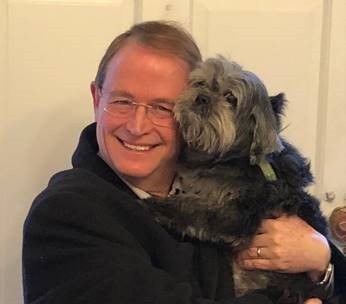
brett-harryWe questioned their judgment when the Coopers asked us to take care of Harry for a week.  We are good people, but we are not dog people.  I have not lived with a dog since my Chihuahua Catastrophe lived up to his name in an encounter with a brand new 1968 Ford Mustang.

Our only goal was to keep Harry alive until his family got home.  We were so afraid that something would happen, but Harry slept most of the time.  He disappears like Harry Houdini into blankets and pillows.

Harry is a combination of Harry Styles and Harry Truman—hip, but wise.  He’s a little Toto, a little Benji, and a lot Ewok.  He is nine years old, so if he was human he would be seven years older than I am.  Harry is a Shih Tzu, a breed not meant to hunt, herd, or protect.  If I fall into a well, Harry will keep the news to himself.

I want us to be Turner and Hooch, but Harry sees our walks as an opportunity to train me to take orders.  My attempts at “Sit,” “Stay,” and “Heel” are met with Harry’s you-don’t-know-what-you’re-doing look.  Several of our walks take place in freezing weather, but Harry likes being a chili dog—though he does not care for that joke.

Harry walks faster than I do so that he can pretend I am not there.  He is fascinated with finding the right pile of leaves, hibernating squirrels, and the backsides of other dogs.  Walking with Harry is interactive.  We speed up.  We slow down.  We move from side to side.  We get excited about parked cars.

New Yorkers ask, “What’s your dog’s name?” more often than “What’s your name?”  I wonder why these people did not talk to me before I borrowed a dog, but I like the subculture of dog people.  They may not speak to one another if they do not have their dog, but there is not a lot of judgment.

I assume Harry and I are friends after our week together, but he could be thinking Cujo thoughts and I would never know.  Though Harry seems unimpressed with me that does not keep me from being wild about Harry.  Petting Harry is like singing the blues.  You feel better though you are not sure why.

Hanging around Harry is good for my soul.  Politics is ugly.  Work is stressful.  People can be difficult.  Harry does not care about any of that.

I talk to Harry a lot.  He is not attentive, but he does not interrupt.  Talking to Harry is like talking to myself, which is just a little bit like praying.

Abraham Lincoln said, “I care not much for a man’s religion whose dog is not the better for it.”

Caring for animals may seem unimportant with all of the problems in the world, but the message of loving one another, loving animals, and loving creation is a hopeful word in a troubled time.  When good churches have food drives they include dog food.  They take pets to visit the sick and host adoption events.

When St. Francis talked to animals they talked back, but I can only imagine what Harry is thinking:  “You could learn a lot from me.  The past is gone.  The future isn’t here yet.  Enjoy the moment.  I appreciate what I have.  I don’t sit around wishing I was Lassie.  I don’t want to be a terrier or a boxer or a poodle.  I am fine with who I am.  Be happy with who you are.  There’s a reason all dogs go to heaven.  We don’t care about money.  We don’t worry ourselves to death.  Dogs don’t hold grudges.  We aren’t judgmental, like cats.  You are too easily frustrated.  You should chase things.  Jump for joy when you’re happy.  Get excited about whatever is in front of you.  Wag your tail because life is good.”

We grow in our faith in a variety of ways.  We worship.  We read.  We pray.  We listen.  We walk the dog.

BrettYounger_SignatureTransparent

Share

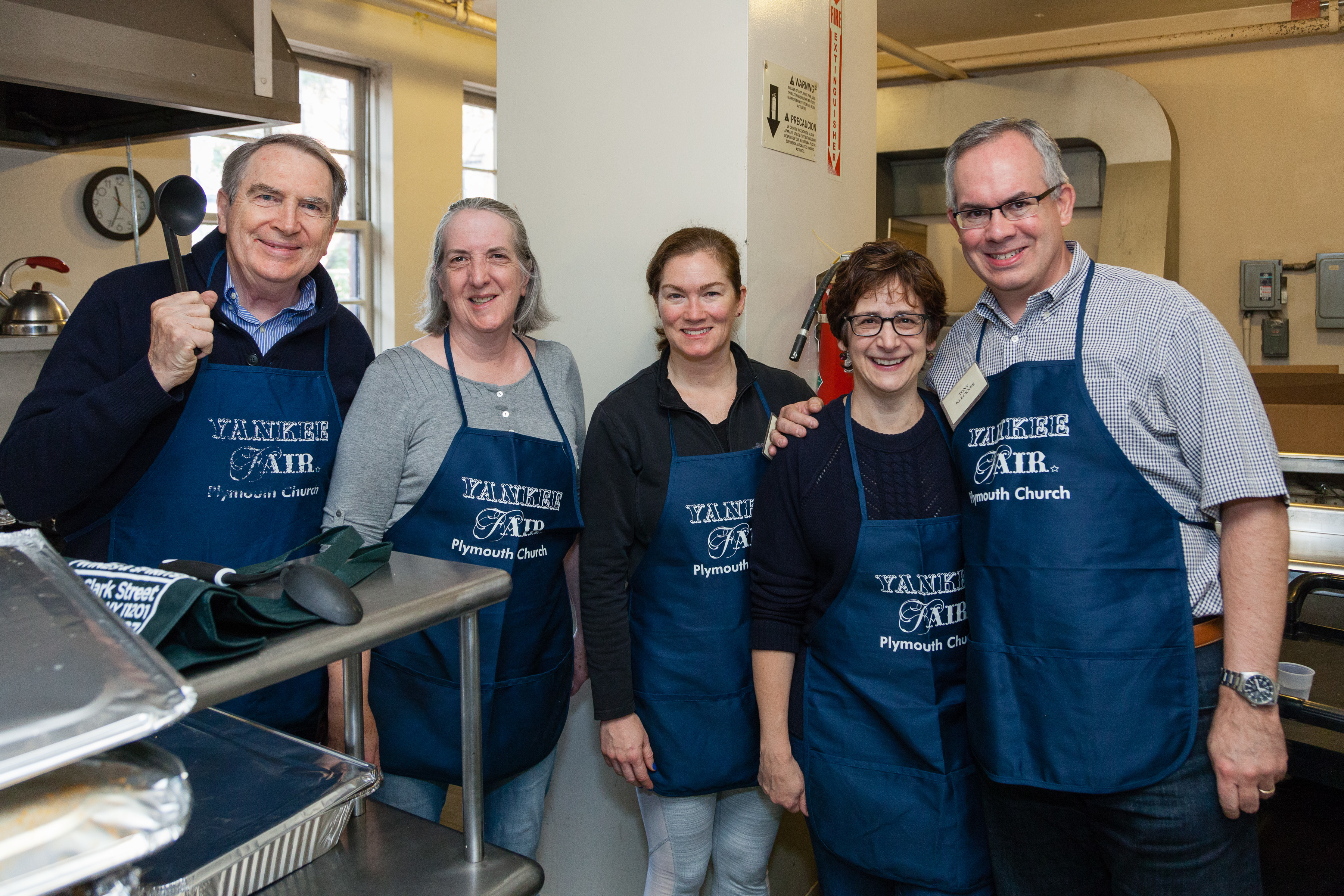
Fair of The Plymouth Church

“Fair of The Plymouth Church – Tomorrow, at 10 o’clock p.m., the ladies of the Plymouth church open their fair in the rooms devoted to the meetings of the ‘Social Circle,’ over the lecture room of the new church, in Cranberry street.  We learn that the ladies of this church have had their fair in contemplation for a long time, and have wrought a great variety of useful articles which will be for sale at fair prices….”

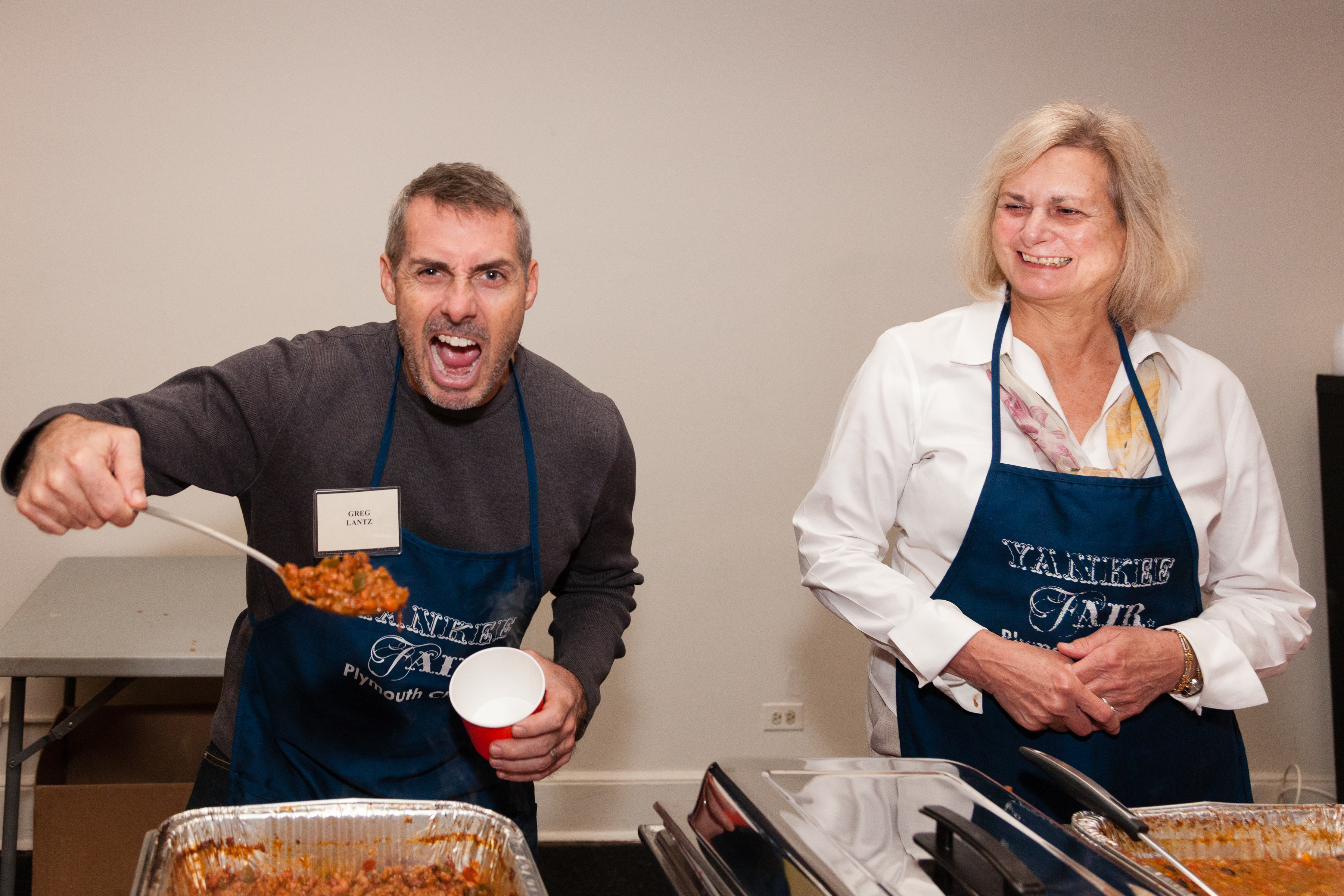
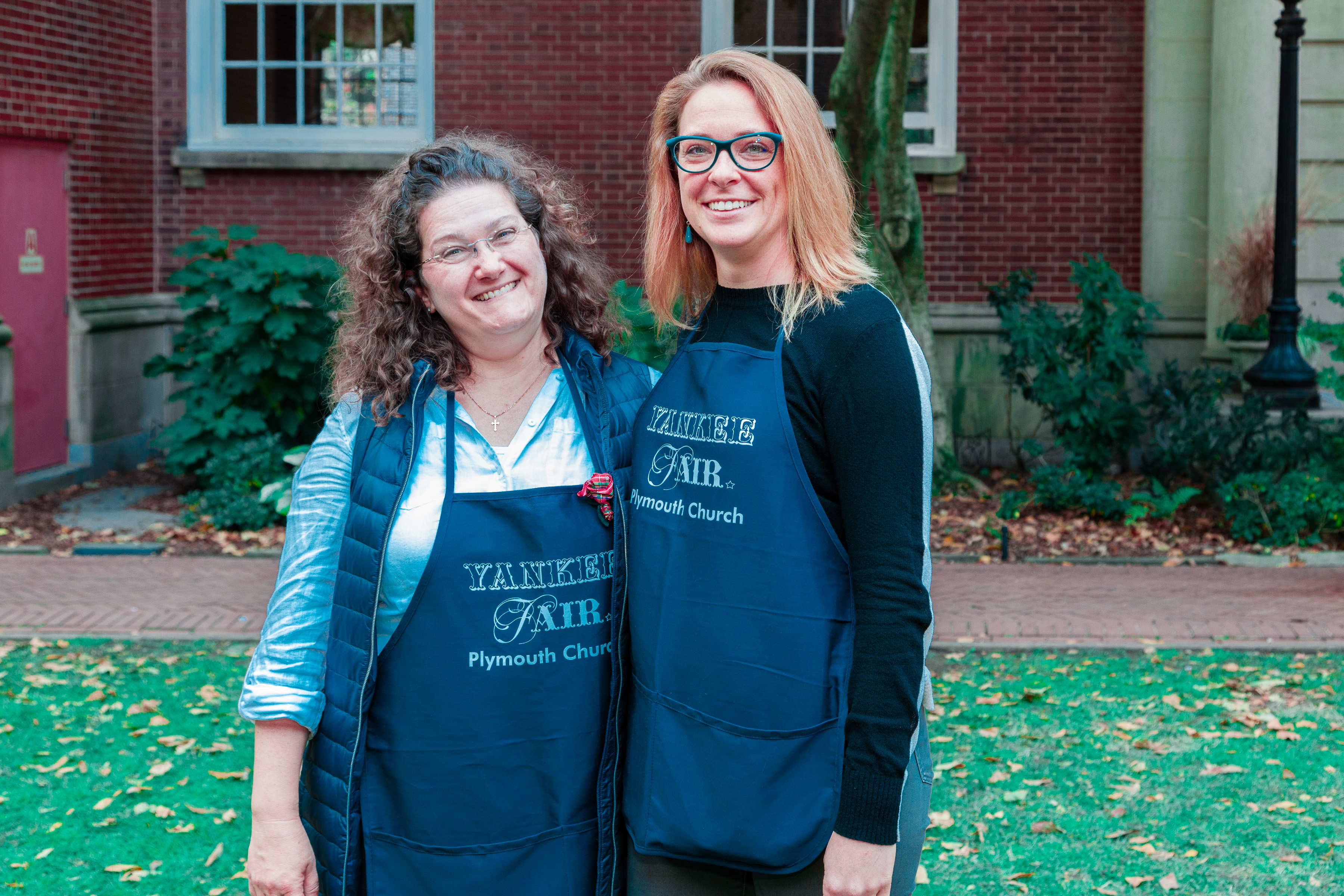
When Whitney and I began our planning last Spring, we knew we had a big shoes to fill and big expectations to satisfy.  We kicked off with a lunch for former YF chairs hosted by Sharon Humphries, which yielded over 10 pages of notes of many wonderful ideas, sage advice and warnings, as well as hilarious YF stories and finally (and thankfully) offers to help!  One big take away from that meeting was that a Yankee Fair is really only as great as the sum of its booth chair. With that in mind, Whitney and I buckled down recruiting our leadership level volunteers.  Many coffees, emails and meetings later we were staffed.

Historically, the leadership at Yankee Fair has tended toward the female, but given all the dedicated men in our community, we wanted to expand our volunteer base, so we asked David Burrell to lead the men’s group in the service of lunch.  A daring task which he nonetheless accomplished with fierce determination.  We applaud the men who served lunch on November 4 and we pity those who did not.  David Burrell has your number and knows where you live!

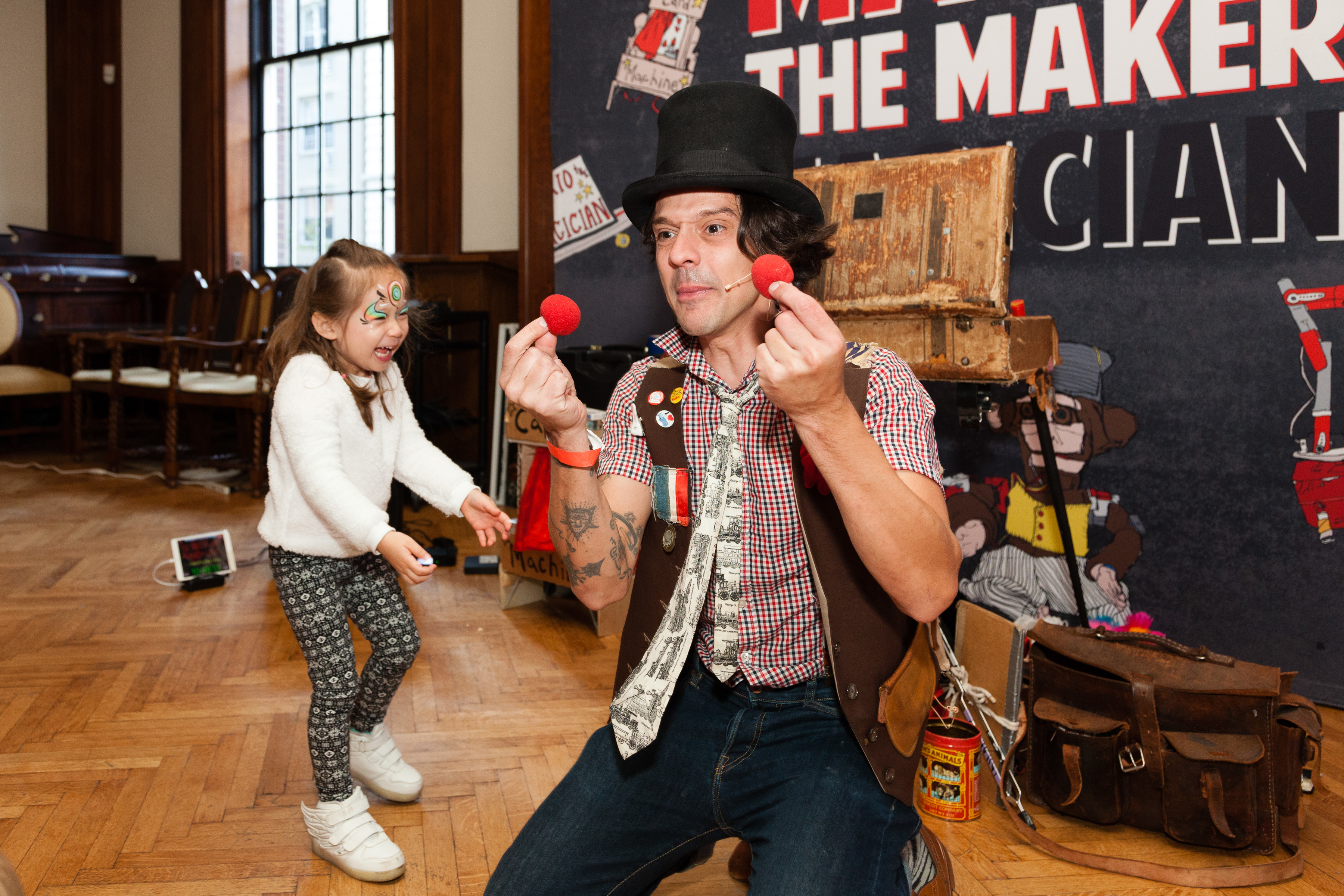
Much of what happens at Yankee Fair, comes together at the last minute of activity. However some things, such as the coordination of the children’s programming, or lunch, or the creation of all the handmade items, happens for months leading up to the fair. For example, Penelope Kulko served many pots of delicious soups which warmed the stomachs of many crafters on many late nights spent cutting and glueing.

Which leads me to this most important observation: fellowship, whether it be found in the sorting of collectibles, toys, books, the serving of lunch, the hanging of buntings or in the flitting about coffee hour with a clipboard to sign up unsuspecting potential volunteers, is the true result of a Yankee Fair well planned. In fact, the best part of Yankee Fair is not the fair, but the collaborative work that makes the fair an actual fair.  What Whitney and I eventually learned on November 4, 2017, is that Yankee Fair is not so much an event to be chaired, as it is a vital part of the church which requires faithful stewardship.  You take your turn at the helm, and leave good notes for those who will follow you.

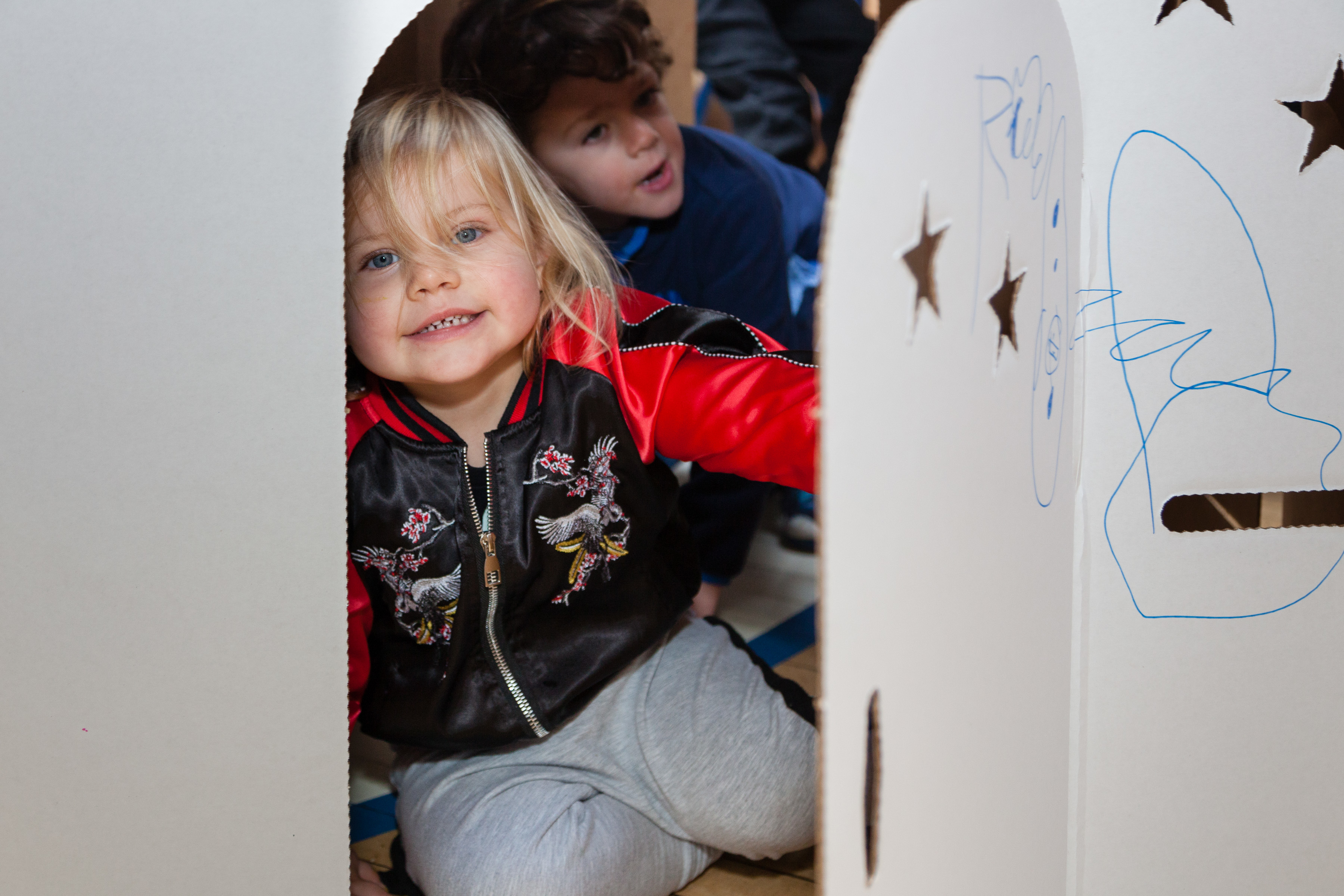
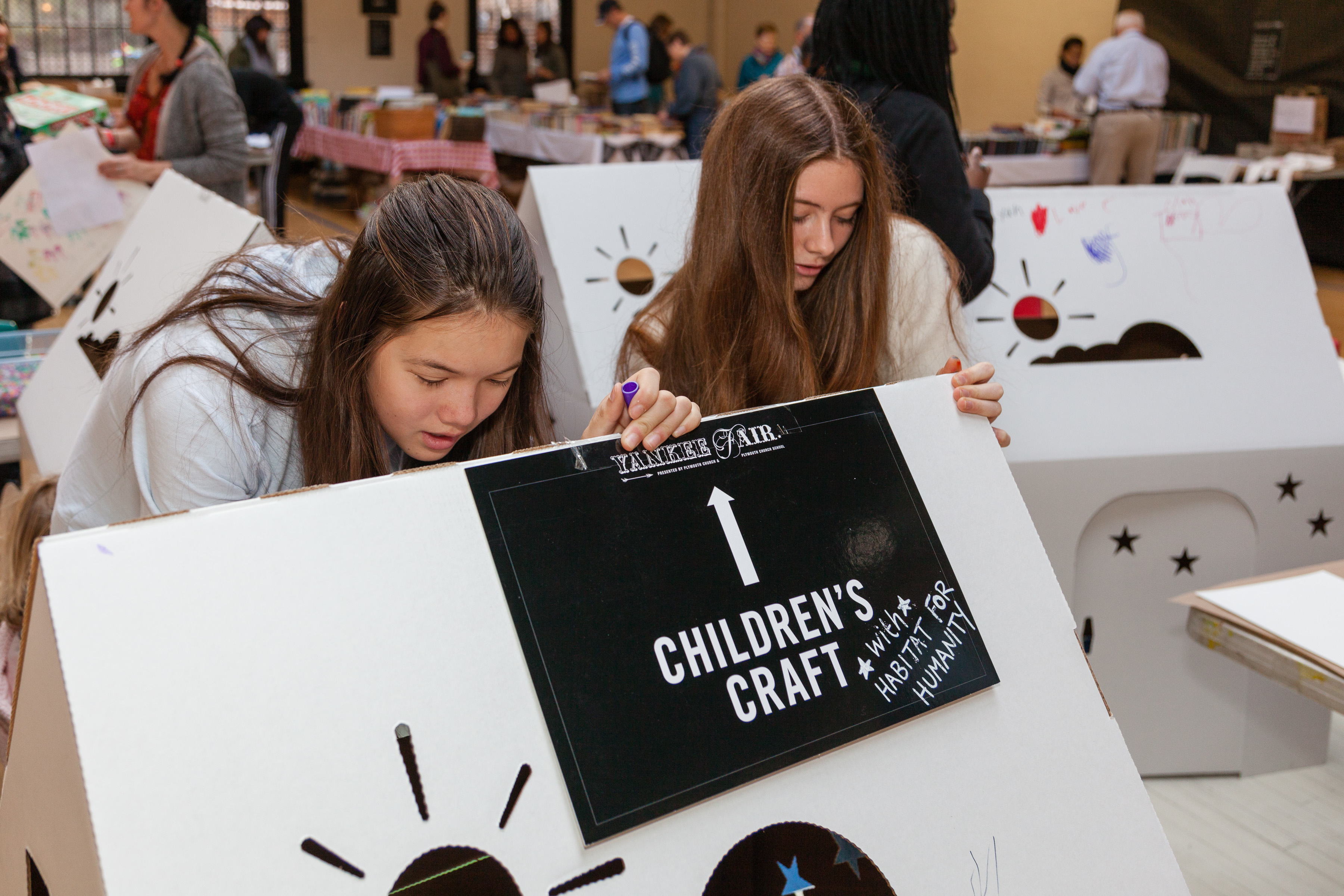
The first fair of 1849 was a benefit to furnish the rooms of the church. Since those early days it has become the tradition of Yankee Fair to find a charity recipient that the entire Church, Church School and neighborhood can all feel comfortable supporting together.  This year, while our neighborhoods undergo significant changes in the affordability in a place that everyone can call home, we thought Habitat for Humanity provided a perfect balance for these various constituents – and it helped that our Christian Help Ministry already had a long standing relationship with the organization.  Having their staff come and participate in the fair with an educational craft event for children in the gym only added to the festivities.  We are very grateful to be able to present them with a check for approximately $9,000!

So now as Whitney and I upload the last of our notes to the Yankee Fair Dropbox, we do so with knowledge that Yankee Fair 2019 will be every bit as wonderful as was the Yankee Fair of 2017 due to the strength and vibrancy of our entire community. Thank you to everyone for making it such a success!

Share

Surprised by Peace

Oh dear God – how do I go from here?

This was my prayer of panic in the 2 AM dark in the waiting room of the cardiac building of Columbia Presbyterian Hospital.  I suddenly realized I was hunched over a small round table, my hands and face wet with tears that finally poured out of me following the most bizarre and incomprehensible 24 hour period of my life.  Standing over me were my parents-in-law, and the heart surgeon who had just informed me that my husband of only four weeks had survived the seven hour surgery to repair a massive aneurysm and dissected valve that had been found in his ascending aorta the day before.  Although my face was hidden, I was keenly aware that the people above me – the only other people still left in the dark waiting room at 2 AM – were watching me with intensity.  It was a moment of total suspension.

The preceding day, Martin had called me to say he was on his way to the ER and I should meet him there immediately.   I had forgotten that he’d gone to see a cardiologist that afternoon, as a precautionary measure, because his brother had had a procedure a few months prior.  We hadn’t paid much attention to it, because we were busy being happy and excited for our wedding over Thanksgiving, and were filled with the promise of the new life we would create together.

So when I received the phone call and Martin used unfamiliar words like ‘massive aortic aneurysm’ I didn’t fully understand what they meant, or why it was so urgent that I get myself from Brooklyn to upper Manhattan that instant.

When I arrived at the hospital, Martin looked completely fine, the same as always.  He had no symptoms of any kind.  Indeed, he had his gym bag with him because he’d intended to lift weights after that doctor’s appointment, just as he did several times each week.

As word of his condition spread throughout the ER, several interns came to look at Martin, curious to see a 43 year old man with an aorta 5 times the size it was supposed to be.  “Wow,” they all said with the enthusiasm of finalists at a national high school level science competition. “It’s amazing – you are actually alive!”

When the surgeon came in, he said, “I have never seen this condition.  Somebody must want you to be here because, medically speaking, you should have died last summer.”  “It’s my wife,” Martin said, which was supposed to be a joke, but I knew he meant it.

I could not fully comprehend what was happening.  Aneurysms, dissected valves and cardio-thoracic surgery are not things newly wedded couples spend time thinking about.  When one speaks vows of “in sickness and in health” and “until death part us,” one doesn’t think those words apply to RIGHT NOW – surely they are meant for much later.

“What if it doesn’t go well?”  I asked Martin.  “I need to know what you want me to do.”

Later, in the 2 AM darkness, after hearing the successful result of surgery, after finally falling into weeping, after feeling the eyes of Martin’s parents and the surgeon watching me intently for what I would do next, after knowing they were waiting for some kind of cue from me, which I could not give, I prayed . . .

Oh dear God.  How do I go from here?  How do I move?  Because I do not understand any of this.  How do I physically make the journey from this moment into the next?  And what on Earth will the next moment bring?

There was no noise.  There was no light in the room.  Nothing remarkable happened.  Very simply, peacefully – I sat up.  And the next moment began, and life moved on.

I often think of that moment in my life.  In the chaos and confusion of a real emergency, that simple movement – from here into there, supported by God’s peace – was the bridge that upheld me as I entered the next unknown.

Maggie Fales
Plymouth Church, Brooklyn, NY
December 10, 2017

Share

Christmas Lights

Every once in a while I see a jogger and react in a way that is incomprehensible to thinking people.  I say to myself, “I should start jogging.”  One spring a few years ago, during such a period of insanity, I began running around a couple of blocks.  The highlight of my stroll was passing an out of the ordinary yard not far from our house.  At night, when the lights are on, it can’t be missed.  The most striking feature is the Christmas lights.  The lights, which cover a Mulberry tree, are a startling variety of colors.  A red birdhouse with a black roof invites passersby to “See Rock City.”  A big red bow adorns a holly wreath.  It’s hard not to smile at the yard.

In a conversation with someone who lived a few doors down I asked, “What’s the story with your neighbor’s Christmas lights?  That’s an interesting yard.”

The yard is not as amusing to him as it is to me:  “Those stupid Christmas lights have been up for years.  It makes me furious when I think about what that yard does to my property values.  I am sorely tempted to buy a BB gun just to shoot those &%$* lights!”

I started to rethink my feelings.  Perhaps the yard wasn’t as wonderful as I originally thought.  Maybe I would feel differently if I lived next door.  Then one evening, as I was leisurely making my way I saw a woman working in “the yard” just up ahead.  I sped up so that ten minutes later, when I was in need of a break anyway, I was able to stop and say:  “Your yard is really interesting.  Is there a story behind the Christmas lights?”

She smiled, “Yes, there is.”

She pointed to the house across the street and identified a particular window:  “The elderly woman who lives there came to stay with her children seven years ago.  She’s in her nineties now and seldom leaves her room.  After her first Christmas here she went on and on about how much she enjoyed looking at the lights and bright colors in our yard.  We’re the only view she has.  When Christmas was over, we didn’t have the heart to take the lights down.  We decided that as long as she’s around, we’d leave the lights on.”

In a world full of darkness, we need to leave the lights on.

BrettYounger_SignatureTransparent

Share

Helping the Holiday Hurt

The Christmas season can be a time of celebration for many people in our community. Twinkling lights on Montague Street, Christmas carols played by street musicians, and bedazzled storefront windows can stir feelings of wonder and joy. While it is easy for us to get caught up in the splendor of Advent, we must remember that for many people Christmas is a time of sadness, stress and grief.

The holidays make pain more painful. For those facing the recent death of a loved one, the loss of a job, financial hardship, the breakdown of a relationship, or a physical or mental illness, Christmas festivities serve as reminders of loneliness and want. If you are someone who hurts during the holidays, here are some suggestions to find some peace while in pain.

Admit the Hurt
Trying to gloss over your hardship or pretend that the pain isn’t there will only create frustration. People are emotional pressure cookers.  If you continuously stuff down uncomfortable feelings, eventually the pressure builds and those emotions will come out one way or the other, usually in bursts of rage or anxiety. During the holidays, make sure that you give yourself moments to express your feelings in healthy ways: take time to cry, talk with a minister or counselor, or write in a journal.

Change Traditions
Holiday traditions are never the same when there is a major change to your life situation. Trying to recreate the happy moments of the past will leave you deeply disappointed. Doing something different for the holidays can ease some of the pain. Some ideas would be to go on a trip, decorate your house differently (or not at all), or plan to eat out on Christmas rather than cooking at home. Even small changes to your holiday routine can make big differences in your emotional state.

Play it by Ear
December is filled with invitations to happy holiday gatherings. Rather than avoid the parties altogether, tell your friends that you hope to attend, but will not be sure how you are feeling that day. Ask if it would be ok if they could plan on you coming, but know that you might have to cancel last minute if you are having a bad day. Friends that are worth your friendship will understand.

Find Support
There is a world of support available to people in pain in the city. Now is the time to seek out that support. You can find grief and emotional support groups online. Multiple AA and Al-Anon groups meet throughout the city each day of the week. There are holiday dinner meet-up groups for those who are alone. Many churches, like Plymouth, will have Blue Christmas services, which are worship services specifically designed to help people cope. If you need help finding support, talk to a minister or counselor and they can give you a list of resources.

Hope in What Really Matters
While the secular world tells us that Christmas is about family, presents, laughter, and fun, we must remember what it is truly about. God entered into the world to give hope to people in pain. Jesus came to earth to teach us that God’s love, peace and joy are available to us at all times, no matter what life throws at us. God’s love is more comforting, God’s peace is more healing, and God’s joy is more igniting than any carol, twinkling light, or adorned window.

Much hope, peace, joy and love to you this Christmas season.

Share

Questions Ginsburg should ask the baker’s lawyer

The most famous bakery in Lakewood, Colorado, is focusing on birthday cakes for a while. In 2012, Dave Mullins and Charlie Craig walked into Masterpiece Cakeshop to purchase a cake for their wedding reception. The owner refused to serve them because they are a same-sex couple.

Jack Phillips’ lawyers will soon be before the Supreme Court. Their argument is that Christians should be allowed to discriminate against those who do not agree with their interpretation of the Bible. Phillips is now a favorite of the right-wing for standing up for Christian business owners’ right to say who should be married.

The Colorado Civil Rights Commission thinks it would be simpler to treat everyone equally under the law. They argue that acting like a bigot is not a right, and that since Phillips’ shop serves the public he has to serve all the public.

Most assume that the Supreme Court’s job in this case is to decide if religious beliefs are a license to discriminate, but there is another way to look at this. If Phillips is really committed to biblical laws, then he should be committed to all of them. Instead of asking if it should be legal to run a heterosexuals only bakery, we should ask who else a biblical legalist should turn away. Refusing to make devil’s food cakes for gay couples may not be enough.

Should Masterpiece Cakeshop make cakes for the weddings of divorced people? Jesus never mentions gay people, but he says, “Whoever divorces his wife, except for unchastity, and marries another commits adultery (Matthew 19:9).” If Phillips is claiming a Christian exemption from U.S. law, how can the baker enforce shaky interpretations of a few obscure texts and ignore the words of Christ?

Should Masterpiece Cakeshop make cakes for people who are overweight? “The glutton shall come to poverty” (Proverbs 23:21). Should the bakery be encouraging sinful behavior?

Should Masterpiece Cakeshop make cakes for people with tattoos?  “You shall not … tattoo any marks upon you” (Leviticus 19:28). Recognizing tattooed customers is easier than recognizing gay customers.

Should Masterpiece Cakeshop make cakes for witches? “You shall not permit a female sorcerer to live” (Exodus 22:18). The bakery’s order form could include the question, “Are you a female sorcerer?”

Should Masterpiece Cakeshop make cakes for people who wear jewelry (1 Timothy 2:9), own a gun (Isaiah 2:4), or say the Pledge of Allegiance (Matthew 5:34-35)?

The Supreme Court will hear oral argument in Masterpiece Cakeshop v. Colorado Civil Rights Commission on December 5. The Court should not let prejudiced people use the name Christian as an excuse to act in opposition to God’s love. Christians should be the first in line to argue for equality for all.

When Christians go to court to defend their own bigotry, they should be forced to admit the inconsistency of what they claim to believe. Citizens are allowed to have deeply held beliefs that make no sense, but citizens should not get to discriminate.

Religious freedom is the freedom to worship without fear of persecution. Religious freedom is not the freedom to decide who gets angel food cake.

BrettYounger_SignatureTransparent

Share

THINKING ABOUT MONEY

Hard to believe, but it was a conversation I overheard when I was just five that helped form my ideas on giving.  I was hanging around the house one day, trying to amuse myself while my mom hosted the Women’s Fellowship. They had tea and cookies, conversation and that day, a visiting speaker.  I lingered in the next room, curious, and heard the visitor talk about giving to church missions.   She was what was called a ‘circuit rider’, a minister who travels among rural parishes, and I knew my parents admired her. She told the gathered ladies, “Last week I bought a sweater; paid $7 for it.”  [In the 1950’s $7 was a lot.]  She continued, “I didn’t need that sweater; it was just something I saw and wanted.  Afterwards I realized that if I could afford to spend $7 on something I didn’t need, then I could certainly afford $7 for something that was terribly needed.  So I scraped together another $7 and gave it to the mission fund.”

I’m not sure why the sweater story made such an impression on me.  But in fact it became a touchstone:  something that still comes back to me.  What did it say to me at age 5?  That there’s a larger world out there besides my own wants and needs.  That I have a responsibility to think about those other needs.  And that money can do good.

Another touchstone came when I was in my 20’s:  Bill Coffin, former pastor of Riverside Church, used to say “There are two ways to be rich.  One is to have a lot of money.  The other is to have few needs!”  He’d also say that an advantage of having fewer needs is that one can be more generous with others.

So I try to think carefully about my needs.  When I spend money on things I don’t really need (and I do that), the ‘circuit rider’ still asks me what I am doing for others.  And what are my needs, anyway?  Some of the things I value most are not things money can buy, but other important things do cost money.  One of those is having a church that can help me grow into the person God wants me to be.  Plymouth Church is an important part of my life, and I want to make sure it’s there, both for me and for others, including those who haven’t found it yet.  I also want Plymouth to grow in its ability to do God’s work in the world.   So I count Plymouth as an important need, and supporting Plymouth financially as an important response to God’s generosity.

Wendy Reitmeier

Share

Someone’s praying, Lord, that we sing Kum ba Yah

The next time someone says, “We don’t need a Kum ba Yah moment,” tell them, “I think we do.”

Musicians who did not know how to play Kum ba Yah were once afraid to take their guitars to camp.  Many of us remember sitting in front of a crackling fire, trying to find the distance at which our front side was not about to burst into flames and our backside was not frozen.  At a deep Kum ba Yah level, the warmth of the fire was catching.  Singing “Someone’s praying, Lord” felt like praying, “Someone’s crying, Lord” felt like shared sorrow, and “Someone’s singing, Lord,” felt like hope.  Lots of us felt that way—and we thought it was cool to sing an African song—even if that was not actually the case.

I learned Kum ba Yah with hand motions.  You can guess the movements for “Someone’s praying,” “Someone’s crying,” and “Someone’s singing.”  I wrote new lyrics for which the motions write themselves:  “Someone’s fishing, Lord,” “Someone’s itching, Lord,” and “Someone’s bowling, Lord.”

Children of the sixties sang Kum ba Yah with Pete Seeger, Joan Baez, and Peter, Paul, and Mary.  Joan Baez’ version included the stanza, “No more wars, my Lord.”  Raffi recorded it for his Baby Beluga album.  There is a mashup involving Ozzy Osbourne that is not helpful, and a rap metal version Kumba Yo! that ministers cannot recommend.  Lots of singers have pleaded for God to “Come by here.”

We do not know who to thank for Kum ba Yah.  One story is that Rev. Martin Frey of New York wrote Come by Here in 1939 and taught it to an eleven-year-old boy.  The boy’s missionary family carried it to Africa where it was put into the Angolan dialect and brought back to the United States.  The problem is that no word close to Kum ba Yah exists in any language spoken in Angola.

Versions of the song were recorded in South Carolina as early as 1926.  The phrase “Kum ba yah” may be a Gullah version of “Come by here.”  The first ones to sing “Someone’s crying, Lord” were African Americans suffering under Jim Crow.  (Indefensibly, most hymnals continue to give Martin Frey credit.)

When people mention Kum ba Yah today it is usually with cynicism.  An African American spiritual in which hurting people plead for God’s help has been turned into a term of derision.  You have to wonder if racism is at work when someone says “I’m not interested in holding hands and singing Kum ba Yah.”

Our culture tends to denigrate compassion.  To join hands and sing Kum ba Yah is to pray together asking God to care for the hurting.  Who decided it was helpful to mock the longing for God or the history of an oppressed people?  Far from pretending everything is fine, Kum ba Yah springs from a much-tested faith.  Someone’s crying and yet they are still strong enough to sing.

In the civil rights era, Kum ba Yah was a call to action.  Kum ba Yah is now shorthand for hopefulness that should not be trusted.  A song about looking to God for courage is laughed at for being naïve.

I have grown weary of the way our culture considers cynicism smart and optimism naïve.  We have more than enough skepticism, sarcasm, and negativism.  We need more compassion, warmth and hopefulness.  We need to debate less and care more.  We need to impress each other not with how many facts we know, but with how honest we are about what we are feeling.

The older I get the more I long for Kum ba Yah moments.  I have spent years learning to be suspicious of warm feelings.  Now I ache for genuine love.

We do not need sharper reasoning nearly so much as we need new hearts.  When we get tired of words, we need to pray for God to fill our souls.  We need hope that pushes bitterness away.

Last weekend at our church retreat, we sat around a campfire and sang Kum ba Yah.  It felt real, and the s’mores were delicious.

BrettYounger_SignatureTransparent

Share